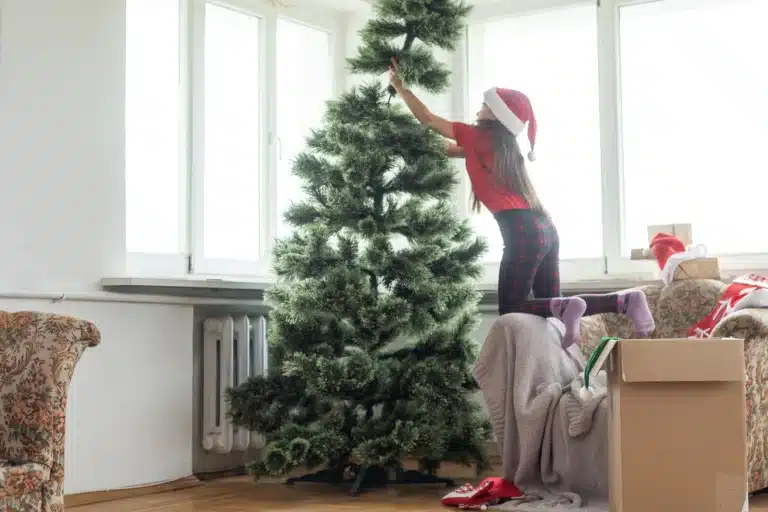
In the UK, Christmas decorations traditionally come down on Twelfth Night, the evening of 5 January. That is the date most families stick to, and the one you will hear quoted every year, usually by the relative who insists everything must be packed away “or it’s bad luck”.
But ask around and you will soon find people who swear by 6 January, others who have the tree out on Boxing Day, and a few who quietly keep the fairy lights on until February. So who is right? Here is the date for this year, where the tradition really comes from, the truth about that superstition, and how to pack everything away so it is ready for next December.
The short answer for 2027
Twelfth Night falls on Tuesday 5 January 2027, so that is the traditional day to take your decorations down. Some people wait until 6 January, the feast of the Epiphany. And if you want to be truly old-fashioned, the medieval Christmas season ran all the way to Candlemas on 2 February.
When Should You Take Christmas Decorations Down?
The traditional answer is Twelfth Night, the evening of 5 January, which marks the end of the twelve days of Christmas.
Those twelve days start on Christmas Day itself, so the twelfth falls on 5 January, and Twelfth Night is that evening. The next day, 6 January, is Epiphany, the day the Three Kings are said to have reached Bethlehem. That is why you will sometimes read that decorations should come down on the 6th instead: it depends whether you count from Christmas Day or from Boxing Day, and whether you see Epiphany as the last day of the season or the first day after it.
In practice, the honest answer is a little less romantic. Most of us take the decorations down on the first free weekend in January, when there is time to do it properly rather than in a rush after work. If you want to follow tradition, aim for the 5th. If you want to do it well, give yourself an afternoon. We will come back to how in a moment.

5 or 6 January? Every Date People Choose
There is no official rule, only traditions, and every household seems to follow a different one. Here are the dates you will hear most often in the UK.
| Date | Who goes for it | Why |
|---|---|---|
| Between Christmas and New Year | The ones who are ready to move on | The festivities are over and they want their living room back |
| 1 or 2 January | Busy households and offices | A fresh start for the new year, before work picks up again |
| 5 January, Twelfth Night The traditional date |
Most British families | The end of the twelve days of Christmas, and the date tradition favours |
| 6 January, Epiphany | Those who count from Boxing Day | The feast that closes the Christmas season in the Christian calendar |
| 2 February, Candlemas | Lovers of old traditions | The official end of Christmas in medieval England, 40 days after Christmas Day |
That last one surprises most people. According to English Heritage, the Christmas season in the Middle Ages carried on right through to Candlemas, and greenery stayed up in many homes until the evening before. So if you are tempted to leave the lights up a little longer this year, history is on your side.
Is It Bad Luck to Take Christmas Decorations Down Early?
No, there is no real reason to worry: the idea that it is unlucky to take decorations down early, or to leave them up after Twelfth Night, is a fairly modern belief.
You have probably heard the warning in some form. Leave the tinsel up past the 5th, the story goes, and you will have a year of bad luck. Some families add that if you miss Twelfth Night, you are meant to leave everything up until the following Christmas, which is quite a commitment.
The history is rather more charming. English Heritage historian Dr Michael Carter explains that the superstition about Twelfth Night is a modern invention. It may come from a much older medieval belief, which worked the other way round: greenery left in the house after Candlemas Eve, at the start of February, was said to become a home for goblins. The fear was never taking things down too early. It was leaving them up far too late.
So if you want your living room back on 2 January, go ahead with a clear conscience. And if you love your lights too much to let them go, you have a few centuries of tradition to back you up.

When to Take the Christmas Tree Down
The tree usually comes down with the rest of the decorations, around Twelfth Night, but a real tree may tell you it is time a little sooner.
A real tree starts to dry out within a few weeks, even with regular watering. Once the needles drop as soon as you brush past, it is ready to go. Many local councils run Christmas tree collections or drop-off points in early January and turn the trees into chippings or compost, so it is worth checking your council’s website for the dates in your area.
An artificial tree can follow whatever date you choose, but it does deserve a little care before it is packed away. Give it a dust, make sure it is completely dry, and store it in a bag that does not squash the branches. Our guide on how to store Christmas decorations walks you through it step by step.
What About Shops, Hotels and Offices?
For businesses, the date matters less than what happens next: many take their decorations down as soon as work starts again in early January, and then face eleven months of finding somewhere to put them.
A shop window display, a lobby tree, garlands for a whole restaurant, the office tree that ends up behind the meeting room door: business decorations tend to be bigger, more valuable and far more awkward to store than anything at home. We collect them from your premises, keep them in a secure, temperature-controlled warehouse with a photo inventory for each site, and bring everything back ahead of your next install date.
Retailers, hotels and multi-site businesses can explore our seasonal storage solutions or book a free call with our team to plan this January’s pickup.

Taking Down Christmas Decorations: A 5-Step Plan
The secret to a painless takedown is doing things in the right order, so that everything goes away clean, sorted and ready for next year.
- Test the lights and take out the batteries. Plug each set in one last time so you know what still works, and remove batteries before they leak.
- Sort as you go. Make three piles: keep, donate and recycle. Broken lights belong at your household waste recycling centre, not in the bin.
- Wrap the fragile pieces one by one. Acid-free tissue for baubles, egg boxes for the small ones, a compartment box for the treasures.
- Clean and dry the tree before it goes away. A little damp shut inside a bag can turn into mildew by summer.
- Store everything somewhere cool, dry and dark. Lofts and garages are hard on glass, candles and electrics, so keep the precious pieces indoors.
For every tip in detail, from winding lights around card to choosing the right boxes, have a look at our full guide to Christmas decoration storage.
No Room for the Boxes? We Collect in January
If your decorations are packed but there is nowhere sensible to put them, we can look after them until next Christmas.
You choose a collection date in January, our team comes to your door, and we can bring bauble dividers, padded tree bags and boxes with us if you need them. Everything is labelled, photographed and kept at a steady 16 to 20°C all year round. In November, we bring it all back before you start decorating.
Four boxes and an artificial tree fit in 5 sq ft, from £9.75 a week. Collection and delivery are quoted separately, and there is no minimum term. Got a bigger collection? Our volume calculator will give you an idea of the space you need.
Whatever Your Date, Pack It Away With Care
Whether you are firmly team 5 January, loyal to Epiphany or secretly holding out for Candlemas, the date matters far less than how you pack things away. A little care now means that next December starts with opening boxes and remembering, not untangling lights or sweeping up broken glass. And if you would rather have the space back until then, we will happily look after your decorations for you.
We collect your decorations in January, keep them safe at 16 to 20°C and bring them back in November. Four boxes and a tree fit in 5 sq ft, from £9.75 a week.